Driving requires more than seeing
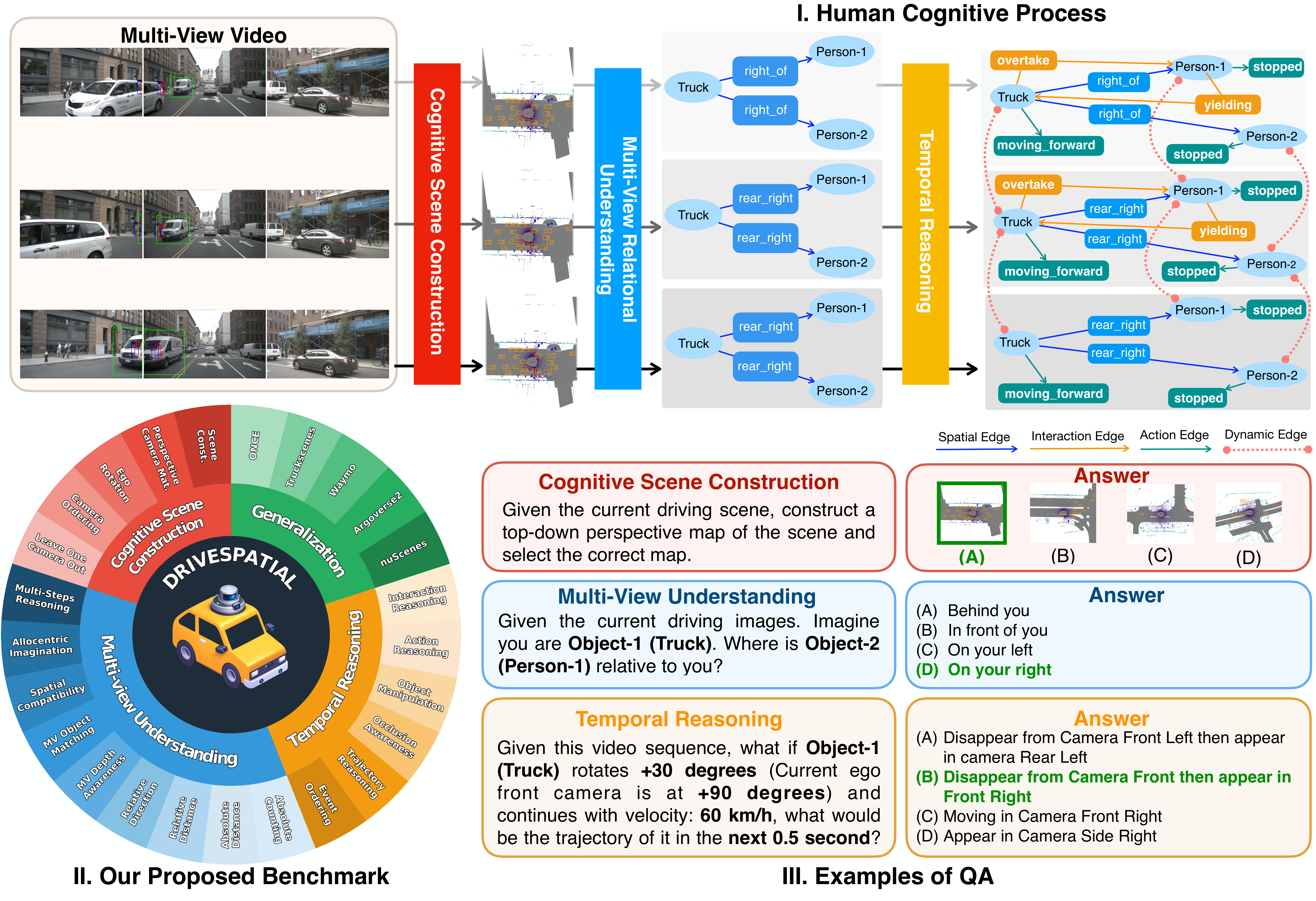
An agent must fuse multi-view observations into one coherent scene, keep objects identified as they cross viewpoints and frames, and reason about how that scene will evolve.
Abstract
Spatiotemporal intelligence in autonomous driving (AD) requires an agent to integrate multi-view observations into a coherent scene representation, maintain object continuity across viewpoints and time, and reason about spatial relations, interactions, and future dynamics. However, existing AD vision-language benchmarks largely focus on single-view, static, ego-centric, or single-source question answering, leaving it unclear whether current Vision-Language Models (VLMs) can truly construct and reason over dynamic driving scenes.
We introduce DriveSpatial, a benchmark of 15.6K human-verified QA pairs across 20 tasks from five large-scale AD datasets. DriveSpatial evaluates four abilities: Cognitive Scene Construction, Multi-view Relational Understanding, Temporal Reasoning, and Generalization. Unlike prior benchmarks, DriveSpatial is generated from a dynamic multi-relational scene graph encoding object states, spatial relations, interactions, camera visibility, and temporal correspondences, enabling QA pairs that enforce genuine cross-view and spatiotemporal reasoning.
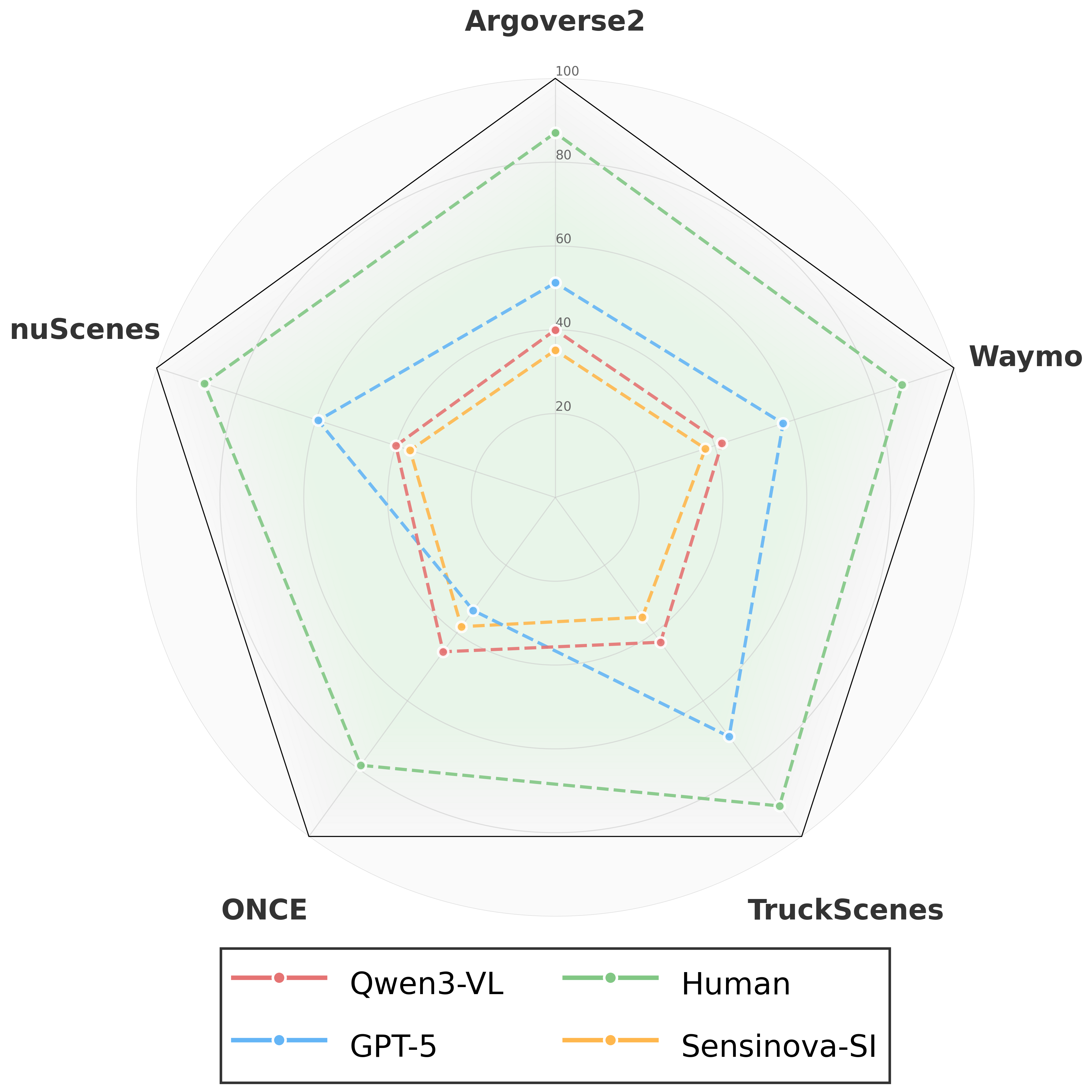
Evaluating 15 representative VLMs reveals a substantial human–model gap: the strongest model trails humans by 28.4 points, with Cognitive Scene Construction as the key bottleneck. Language-only prompting is insufficient, while explicit BEV grounding consistently improves performance.
Four core abilities, 20 tasks
Every question is generated from a dynamic multi-relational scene graph and mapped to one ability, so failures are attributable rather than aggregate.
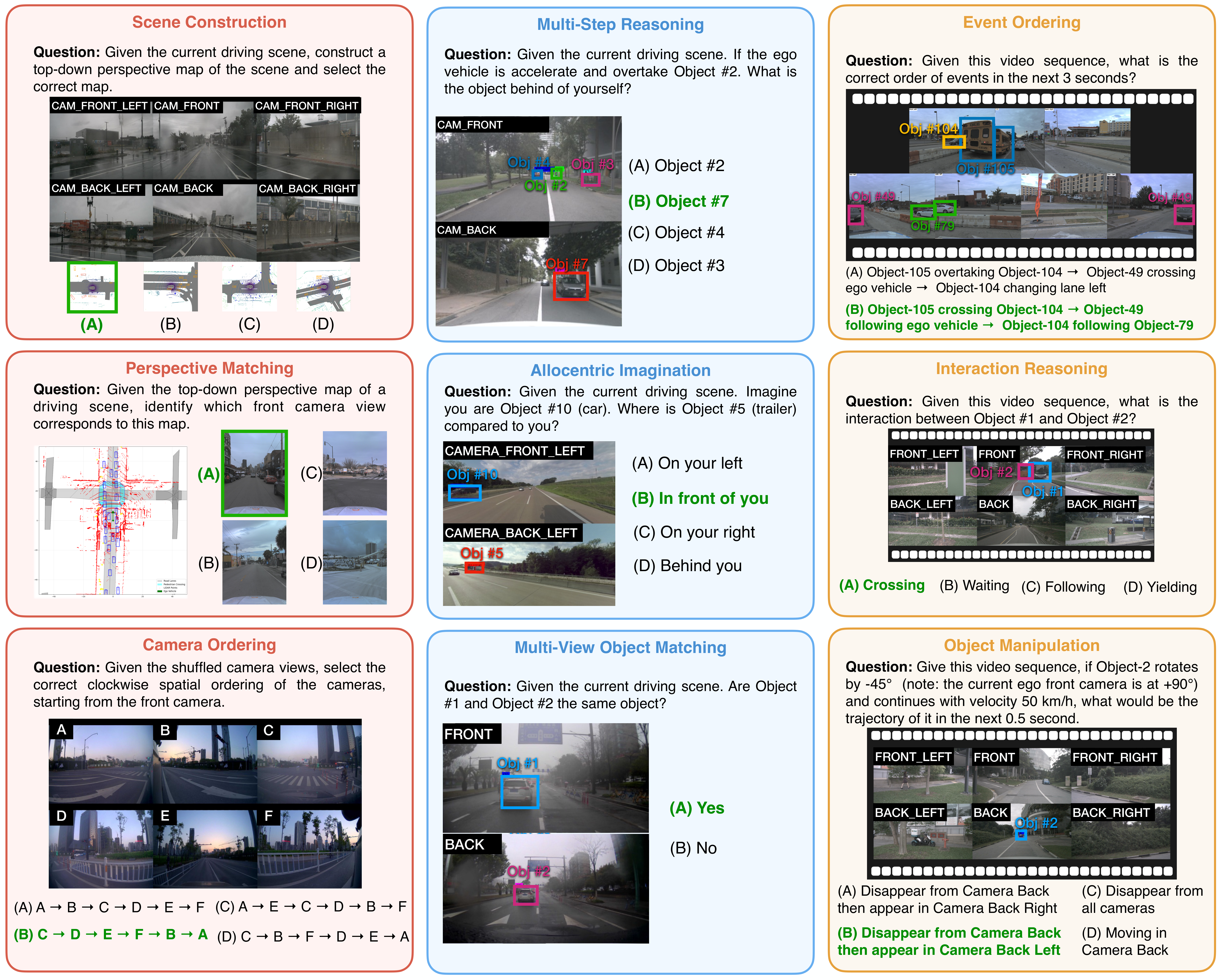
Question examples
Representative samples from nine of the 20 tasks, grouped by ability. Each question requires integrating multi-view camera inputs; correct answers are shown in green.
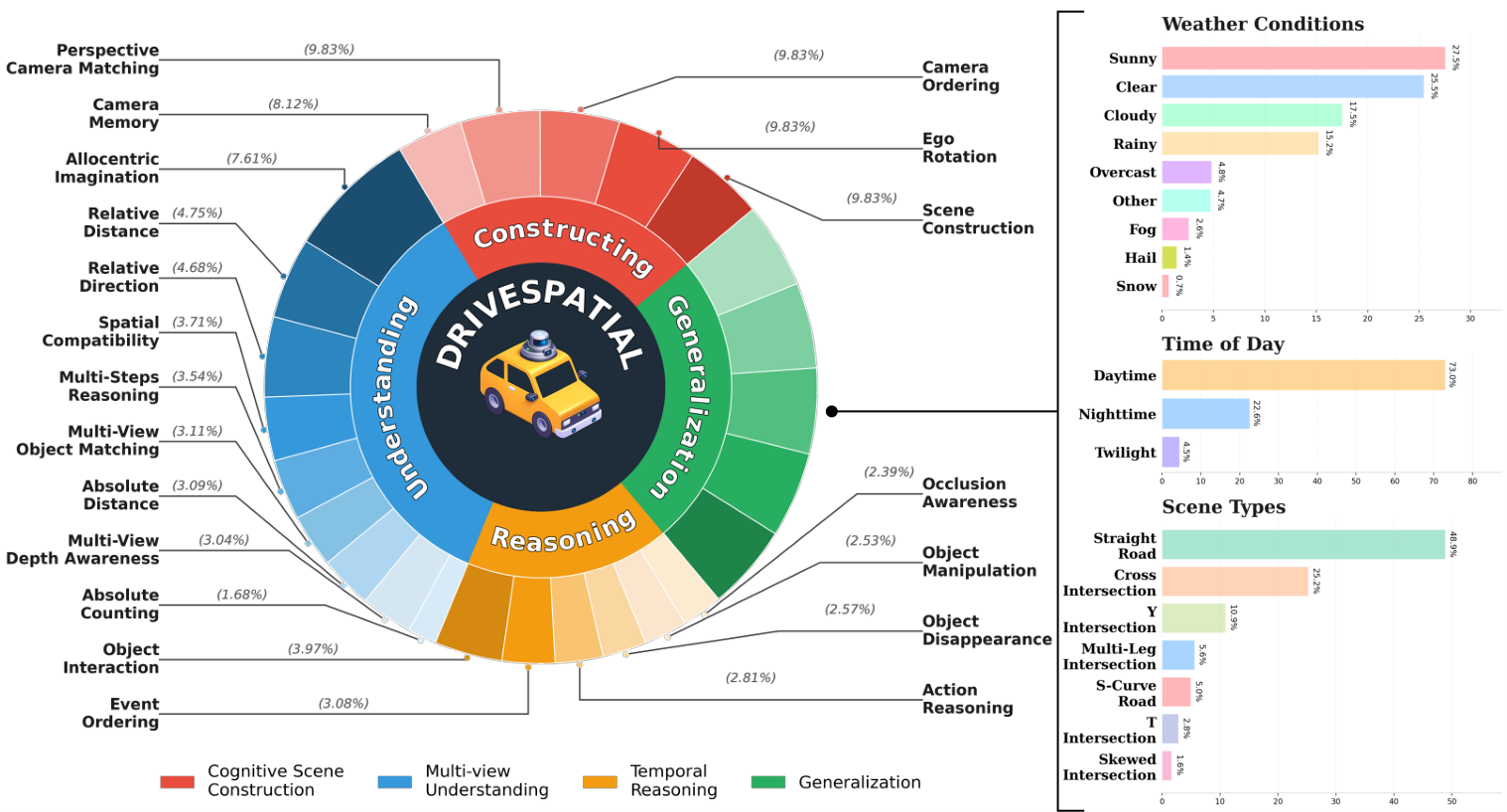
Built from five large-scale AD datasets
Spanning car and truck platforms across diverse weather conditions, scene layouts, and times of day.
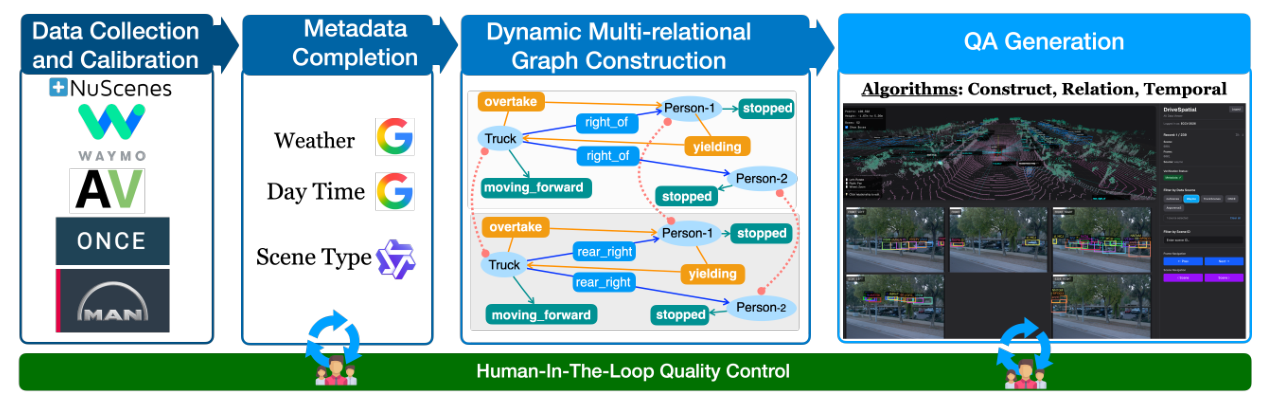
Benchmark construction framework
A four-stage pipeline with human-in-the-loop verification at both the metadata and QA generation stages.
Main results
Fifteen VLMs across three model groups. The human upper bound is measured on DriveSpatial-mini (1,000 stratified questions); ‡ marks models evaluated on that same subset.
| Method | Rank | Avg. | Const.Acc ↑ | Unders.Acc ↑ | Unders.RMSE ↓ | Reas.Acc ↑ |
|---|---|---|---|---|---|---|
| Baselines | ||||||
| Random | 13 | 26.33 | 25.37 | 28.24 | — | 25.39 |
| Frequency | 8 | 32.45 | 32.94 | 33.89 | — | 30.51 |
| Human ‡ | 1 | 83.39 | 86.20 | 85.62 | 10.62 | 88.96 |
| Proprietary | ||||||
| GPT-4o ‡ | 3 | 51.37 | 48.22 | 59.84 | 12.71 | 58.76 |
| GPT-5 ‡ | 2 | 54.98 | 55.20 | 62.45 | 10.41 | 57.69 |
| Gemini-2 Pro ‡ | 4 | 47.26 | 44.09 | 58.51 | 13.20 | 52.38 |
| Generalist — Image-based | ||||||
| LLaVA-Onevision-7B | 10 | 28.65 | 33.73 | 27.64 | 15.76 | 40.34 |
| DeepSeek-VL2-Small | 14 | 24.88 | 23.92 | 26.60 | 15.15 | 39.26 |
| Gemma-3-12B-it | 7 | 35.25 | 35.55 | 44.05 | 14.65 | 40.80 |
| InternVL-3.5 8B | 6 | 36.73 | 39.00 | 44.15 | 14.26 | 41.31 |
| InternVL-3 8B | 16 | 24.20 | 30.63 | 27.26 | 15.95 | 30.65 |
| Qwen3-VL 8B | 5 | 42.24 | 42.76 | 50.62 | 14.32 | 47.66 |
| Generalist — Video-based | ||||||
| LongVA-7B | 12 | 25.91 | 26.84 | 35.90 | 20.26 | 35.25 |
| LLaVA-Video-7B | 13 | 25.24 | 26.94 | 27.57 | 15.68 | 36.89 |
| Specialist | ||||||
| RoboTron-Drive | 18 | 23.14 | 24.31 | 21.03 | 15.49 | 39.56 |
| Ego3D | 11 | 26.48 | 30.21 | 30.67 | 15.95 | 34.53 |
| SpaceThinker | 17 | 24.53 | 27.16 | 31.74 | 16.96 | 31.65 |
| SenseNova-SI | 9 | 30.54 | 37.91 | 36.25 | 15.25 | 32.73 |
‡ Evaluated on DriveSpatial-mini. Avg. = (Const.Acc + Unders.Acc − Unders.RMSE + Reas.Acc) / 3.
BibTeX
@article{vo2026drivespatial,
  title   = {DriveSpatial: A Benchmark for Spatiotemporal Intelligence
             in VLMs for Autonomous Driving},
  author  = {Vo, Hao and Vo, Khoa and Nguyen, Phu Loc and Tran, Sieu and
             Nguyen, Duc Minh and Cuong, Ngo Xuan and Gawugah, Gladys and
             Godavarthi, Sreevenkata Anjani Tishita and Rainwater, Chase and
             Bui, Nghi D. Q. and others},
  journal = {arXiv preprint arXiv:2605.23176},
  year    = {2026}
}